





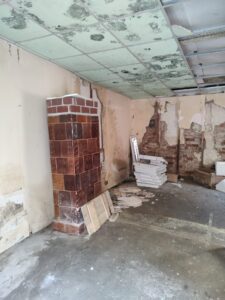
Monaco rent for a ruined space. How Cluj-Napoca City Hall demanded 760 euros per month for 27 degraded square meters and lost definitively in court.
A civil litigation spanning eight years, started in 2017 and definitively concluded in 2025, reveals one of the most eloquent discrepancies between the financial claims of the local administration and the reality of the goods made available to citizens, in a city already suffocated by one of the most expensive real estate markets in Romania.
Cluj-Napoca City Hall sued the occupants of a 27 sq m space located in the city center, requesting that they be required to pay a monthly rent of 760 euros. The argument was a classic one: the “ultra-central” location, treated as sufficient to justify a “premium” market-level rent.
The major problem, completely ignored in the claims made by the municipality, was the actual condition of the space. Although located in the center, the building was in an advanced state of degradation, with major deficiencies, obvious shortages and conditions that could not even remotely support the level of rent requested: no running water, no gas, no electricity, no toilet, cracked walls, a destructible building.
However, in the first instance, the city hall’s request was admitted, and the rent of 760 euros was judicially validated, in an approach that treated geographical positioning as an almost exclusive criterion, to the detriment of the material reality of the property.
Only on appeal was the situation re-established on a real basis. Through the administration of evidence and a detailed evaluative expertise, it was demonstrated that the initial evaluation was divorced from reality, and the financial claims of the public authority were completely disproportionate to what the space actually offered.
The appeals court found the situation absurd and reduced the monthly rent from 760 euros to 160 euros, almost five times less. The direct consequence was a decrease in the total debt by approximately 40,000 euros, in favor of the tenants.
The decision rendered on appeal was upheld in full on appeal, becoming final. Moreover, after five years of litigation, the court ordered the local authority to pay the sum of 4,000 euros in legal costs, holding that it had substantially lost its claims.
The case was handled by lawyer Ștefan Bălan, from SCA Trifan, Cuibuș, Bălan, who emphasized that the case is relevant not only for the parties involved, but for a much broader phenomenon:
“You can’t demand Monaco rents for spaces that look like they were bombed. The fact that a building is located in the city center does not exempt the public authority from the obligation to maintain it and make correct assessments. In this case, the claims were completely divorced from reality, and the courts were forced to correct an obvious abuse.”
The case raises serious questions about how the local administration understands how to relate to citizens, in a city where real estate prices are constantly invoked to justify high rents, fees and taxes, but where the quality of goods and services offered remains, in many situations, at a level far from the financial claims made.
The case demonstrates that the “excessive” real estate market in Cluj is often used as a cover for exaggerated financial demands, even when the reality on the ground indicates degradation, lack of investment, and a structural indifference to minimum standards.
After eight years of litigation, the courts have put an end to a situation that should have been obvious from the beginning: you cannot demand luxury rents for spaces below a minimum subsistence level.